


Without ZapDigits
- Copying data between 10+ tools
- Spending hours building reports
- Recreating the same dashboard for every client
- Sending ugly spreadsheets and screenshots
- Clients asking “so… how are we doing?”


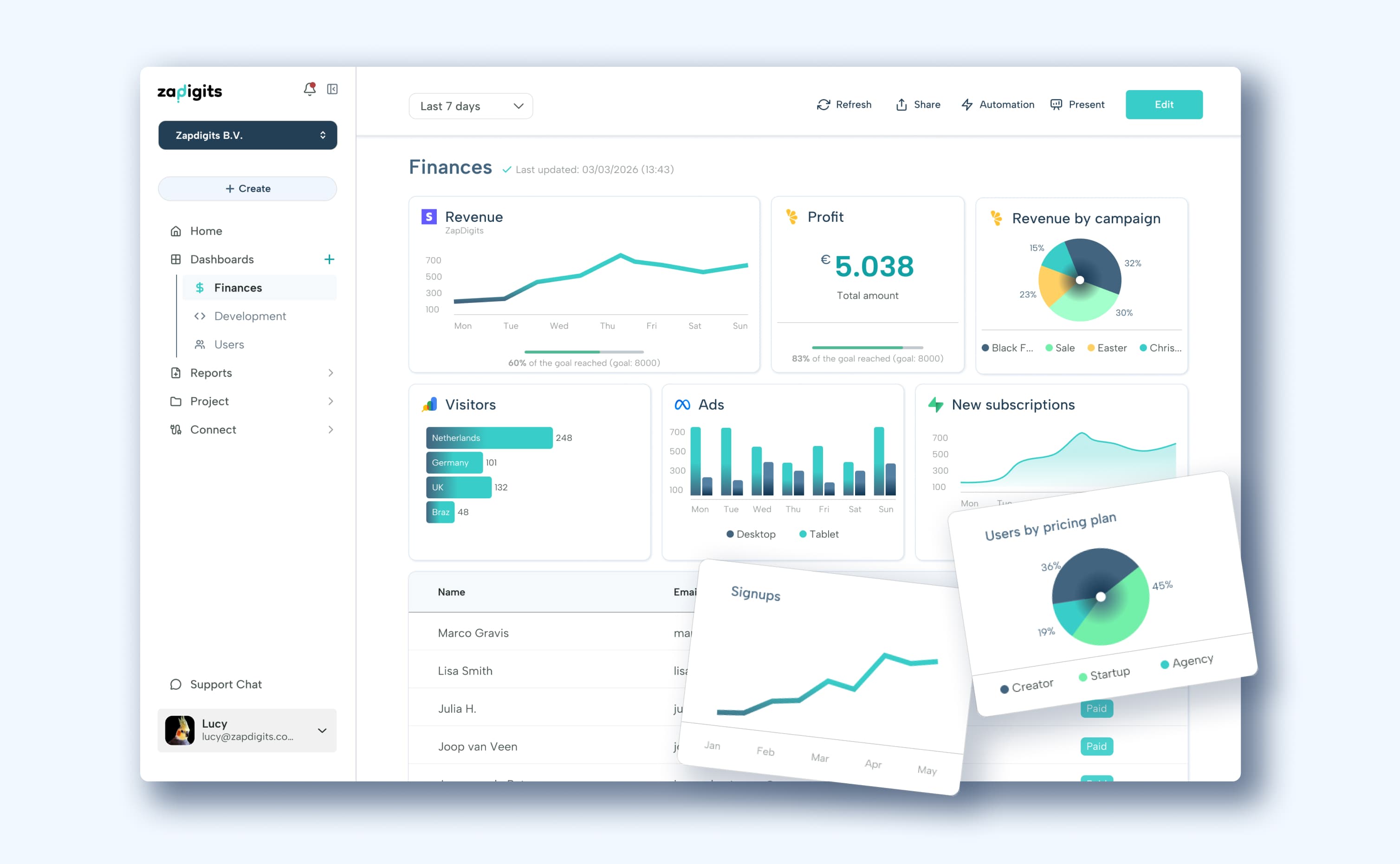
Client reports





















Reporting shouldn't be complicated.
Trusted by agencies around the world



This product was a great addition to our company. It was so easy to integrate analytics and SEO in one dashboard! And the set up is soooo easy. Totally recommend it!!!
Stop worrying about usage-based bills. Team covers up to 10 clients ($46/mo), Agency up to 20 ($249/mo)—not per client like the tools on the right.
10 clients
Team · up to 10 clients
10 × 2 hrs × $40/hr
Estimated ROI
13.9×
Monthly time savings divided by your ZapDigits plan cost
Reporting ROI
Set your clients and hours on the left. We estimate time saved with ZapDigits and subtract your plan so you see net savings and ROI.
Active clients: 10
Tips, strategies, and insights on analytics, reporting, and data-driven growth for agencies.
What if the review tool with the longest feature list is the worst fit for your business? That's the gap most buyers miss. Every vendor promises monitoring, responses, and reporting, but those words mean something very different for a single-location plumber, a 40-store franchise, an agency managing 20 clients, and an online store chasing product reviews. This comparison groups 11 options by who they serve. You'll see pricing transparency, white-label depth, monitoring coverage, and the contract terms that usually surprise people after signing, not just feature checklists. The stakes aren't abstract. The BrightLocal 2024 Local Consumer Review Survey found that 75% of consumers always or regularly read online reviews when evaluating local businesses, and 41% use three or more review sites before deciding. One profile isn't your reputation. You need coverage, fresh reviews, and a response workflow your team will use. Pick by buyer type first, features second. Table of Contents 1. Synup What Makes It Different 2. GatherUp 3. BrightLocal 4. Grade.us 5. Reviewshake 6. Reputation 7. ReviewTrackers Where to Probe Before Buying 8. NiceJob 9. Birdeye 10. Podium 11. Yotpo Review Management Software Comparison at a Glance Choosing Your Tool and Getting Review Data into Client Reports Synup Synup suits agencies and multi-location brands that are tired of running listings, reviews, social posts, and local SEO in separate tools. It's positioned as review management software inside a broader local marketing platform, built around an AI agent called Sydekick. Sydekick doesn't just draft text. It works through playbooks and approval workflows, monitors reviews across sources, drafts replies, requests approval, and publishes once you sign off. Every proposed and completed action lands in a full audit trail, which matters when clients ask who approved a sensitive response. What Makes It Different Listings tied to reviews: Profiles sync across Google Business Profile, Apple Business Connect, Bing, Facebook, and 100+ publishers, with audits and automatic corrections. Review generation built in: Short links and message flows turn recent customers into reviewers without a separate tool. Per-location voice: Brand voice and memory are set per client and location, so replies don't sound identical across a portfolio. Agency delivery: A multi-client command center, white-label client portals on custom domains, scoped permissions, and scheduled branded reporting. AI search visibility: Answer Engine Optimization checks presence in ChatGPT, Gemini, and Perplexity and flags citation gaps. Pricing includes all features on every plan, with tiers varying by location count and agent throughput. That avoids the common trap of discovering a needed module sits on a higher tier. Confirm throughput limits against your review volume before you commit, especially with thousands of locations. I recommend Synup when the main issue is fragmented local work across many clients or stores, and you want governed automation rather than fully hands-off AI. A single-location business that only needs review requests will find it more platform than it needs. GatherUp GatherUp pairs public review generation with private feedback, which is why agencies like it for client reporting that goes beyond star ratings. You can explore the platform on the GatherUp website. It monitors 100+ sites, sends review requests, and adds surveys and Net Promoter Score workflows. That combination helps you catch an unhappy customer privately, learn the cause, and still build public proof from happy ones. White-label options let you deliver it under your agency brand. Published pricing lists $99 per month for one location billed annually, or $60 per month per location for multiple locations. Agency pricing is custom, and that's where you should press for specifics in writing. Strength: Client portfolios get branded delivery without building your own dashboard. Strength: A 14-day trial with no credit card lets you test with a real client. Trap: Listings Management and Review Defense cost extra, so model the full bill, not the base price. Trap: Locations generally can't be removed from annual plans until the term ends. Churn a client midyear and you're still paying. AI-crafted replies save time, but keep human approval on negative reviews. An obviously templated response to a serious complaint damages more trust than a slower, personal one. BrightLocal BrightLocal makes the most sense when review work is already bundled into a local SEO retainer. The BrightLocal platform puts reputation management beside rank tracking, listings, and local search reporting, so account teams can discuss reviews and visibility in the same client conversation. Review monitoring covers 80+ sites, with review requests and reputation reporting in the same toolkit. For an SEO agency, that proximity matters: you can show a client that a rating drop coincided with a visibility drop, then connect both to profile data in your Google Business Profile reporting instead of arguing from screenshots. Pricing varies by location count and billing choice, so total locations across the portfolio should drive the evaluation rather than a single-client plan. Public entry pricing still makes BrightLocal easier to budget than sales-only reputation suites. The trade-off is focus. Review management is one module in a broader toolkit, and some replies may require visiting the original site, which breaks the one-inbox promise. Test each client's main platforms during the evaluation and note where direct posting works. Grade.us Grade.us was built for agencies, SEOs, and resellers, and the delivery model shows it. The platform leads with white-label funnels and branded client reports, so clients see your logo on every touchpoint. That focus suits a small agency selling reputation as an add-on service. You get automated review requests by email and text, monitoring across 100+ sites, a central dashboard, and sentiment analysis. There is little enterprise analytics depth here, and that is the point. The feature set covers what a retainer needs without charging for what it does not. Grade.us's public pricing is unusually clear: $99 per month for one location, $60 per location for 2 to 10 locations, and agency plans starting at $400 per month. Run the numbers against your portfolio before the sales call. Ten locations under one client already cost $600 a month on the per-location tier, which is what the agency plan exists to cap. Practical rule: Model Grade.us at your expected location count in month 12, not month 1. The gap between those two bills is where margin disappears. Two limits deserve attention during evaluation. Some advanced white-label features and agency terms require contacting sales, so confirm exactly what your tier includes before committing. The basic trial may not include SMS or selected features, which means it will not fully prove a text-based request flow. If review requests by text are part of your offer, ask for SMS switched on before you start testing, or the trial tells you nothing about the channel your clients will use. Reviewshake Say you're an agency with eight clients and you want predictable costs this quarter. Reviewshake fits that scenario better than quote-based tools. Details on the Reviewshake website describe monitoring on Google, Facebook, and 100+ other sites, email and SMS invitations, AI reply drafts, review widgets, and branded client dashboards with scheduled reports. Clients can log into a dashboard carrying your branding and domain, which cuts down on "send me an update" emails. The agency plan starts at $199 per month, or $159 per month billed annually, for 10 client accounts and 25 locations. Published capacity makes margins easy to calculate. Divide the fee by your retainers and you know immediately whether the service pays. Published caps are not a weakness. They tell you exactly when you'll outgrow the plan, so price client 11 accordingly. Those caps are also the main constraint. Passing 10 clients or 25 locations means add-ons or a new arrangement, and SMS allowances are limited. Check support for each client's key review sites too, especially niche industry platforms. A tool that covers Google perfectly but misses the directory your healthcare client cares about isn't covering that client. It offers a 14-day trial without a credit card. Use it with your highest-volume client, not your quietest. Reputation Reputation serves multi-location brands and enterprise teams. It connects review collection, monitoring, and AI-assisted responses with listings, surveys, and broader customer feedback analytics in a single suite. That breadth pays off when a brand team needs brand, region, and location views in one place. A regional manager can spot one weak territory while head office tracks whether complaints repeat across stores. When review themes start distorting how AI systems describe a brand (the pattern covered in this analysis of brand hallucination in AI answers), the cross-location view helps you fix source data rather than argue with the output. Per-location pricing is published, so you can budget before a sales call. Listed pricing on the Reputation website is $80 per location per month for Rep Core, $115 for Rep Core + Pulse, and $150 for Rep Core + Surveys. Transparent pricing helps, but multiply it out: 200 locations on the top tier runs $30,000 a month before add-on services. Some capabilities require sales engagement, so get the included product list written into the contract. For a small agency handling basic review responses, this is more platform, process, and cost than the job needs. For a brand managing hundreds of locations under one reputation team, the maths is at least knowable upfront. ReviewTrackers Monitoring tells you what customers said. ReviewTrackers focuses on what it means and how you stack up against competitors. The ReviewTrackers platform consolidates reviews from 100+ sources and adds experience analysis and competitor insights. For agencies, that analysis is the reportable value. Saying "your rating rose" is weak. Showing that wait-time complaints fell while a named competitor's rose is a renewal conversation, especially when you place it alongside other KPIs using the approach in this roundup of marketing dashboard reporting tools. Where to Probe Before Buying Pricing: It's custom and based on location count and plan, so there's no self-serve budget check. Direct replies: Confirm which sources let you post responses from inside the product and which send you elsewhere. Plan gating: Verify that the data sources and analysis features shown in the demo are in your quoted plan. Unlimited users on core platform plans is a genuine plus for larger teams, since seat fees punish collaboration. I recommend ReviewTrackers when competitive benchmarking is part of your pitch. If clients only want requests and replies handled, cheaper agency tools will do that job. NiceJob NiceJob is the simplest path on this list for a local service business that wants more reviews without an operations project. You can review the plans on the NiceJob website. It automates review requests by SMS and email, provides a review page, and turns results into website widgets and social shares. For a plumber, cleaner, or dental practice, that visible proof on the homepage often matters more than deep sentiment analysis. The higher tier adds AI replies, referral campaigns, and NPS surveys. Pricing is public and straightforward. Starter is $75 per month and Pro is $125 per month, with no long-term contracts and a 14-day trial. Month-to-month terms remove the biggest risk for a small business testing whether staff will send requests consistently. The limits show up at agency scale. It's less focused on white-label reporting across a client portfolio than GatherUp or Grade.us, and Starter lacks several Pro features, so check the tier split carefully. Verify integrations against each client's booking or CRM system too. Automated requests only work if the trigger data flows in reliably after every completed job. Birdeye Birdeye sells consolidation. The Birdeye platform bundles review generation and responses with monitoring, analytics, listings, messaging, and multi-location management under one vendor. That makes sense for a larger client whose team already juggles separate tools for each of those jobs. One contract, one login, and AI-assisted review generation and replies can reduce vendor sprawl. Multi-location support is core to the design rather than an afterthought. The cost is opacity and breadth. Pricing is quote-based and depends on locations, products, and business needs, so you can't sanity-check the budget before a sales process. And if your agency only needs review management, you'll likely pay for messaging and listings capacity you never deploy for some clients. Ask Birdeye for a quote broken down by location and product module. A single blended number hides which parts you're subsidizing. Also confirm contract length, onboarding requirements, and what happens to your review request workflows if you leave. Consolidation cuts both ways. The more workflows sit with one vendor, the more disruptive an exit becomes, so portability terms deserve attention before you migrate a whole client onto it. Podium Podium starts from messaging, then attaches reviews to the conversation. The Podium reviews product automates invitations and reminders and consolidates reviews in an inbox alongside customer messages, profiles, and mobile access. That design suits service businesses where the same front-desk or field team texts customers all day. A review request becomes the natural end of an existing thread instead of a separate campaign someone forgets to run. Reporting on review activity and attribution helps you show which locations and staff generate feedback. AI-assisted invitations and replies speed things up, but govern them. The recent consumer research on AI review management found that 46% of US consumers would distrust a reply that appears AI-written. Keep a human approving sensitive responses and edit drafts so they reference the customer's actual experience. Pricing isn't published on the review product page. Get contract length, location counts, and message allowances in writing before signing. If you don't need the broader communication platform, a focused review tool will usually cost less and onboard faster. Yotpo Yotpo solves a different problem. It's built for product reviews on online stores, not reputation across local listings. The Yotpo platform collects post-purchase reviews, photos, and videos, then displays them through product page widgets and star ratings in the shopping journey. Automated requests go out after purchase, moderation keeps published content clean, and eligible plans add syndication, which matters when you sell the same products across channels. For a retailer, a photo review on the product page does conversion work that a Google rating one click away doesn't. Pricing is where buyers get caught. Paid plans are tiered by monthly order volume, and the higher tiers are custom-priced. A strong sale month can push you into a new bracket, so forecast your cost at peak volume rather than the monthly average. A limited free option helps smaller stores start, while advanced analytics and enterprise features sit in higher tiers or require a quote. Don't buy Yotpo to manage a law firm's local reviews, and don't buy a local tool to run product reviews. Category fit beats feature count here. Review Management Software Comparison at a Glance All 11 platforms appear below in the order reviewed above. Four publish no starting price, and the best rates from GatherUp and Reviewshake assume annual billing. Reputation prices per location, so its total climbs with site count while flat monthly plans stay fixed. Tool Starting price Free trial White-label options Best for --- --- --- --- --- Synup Quote-based; confirm with vendor Confirm with vendor Full white-labeling, custom domains, and client portals Agencies and multi-location brands managing local marketing at scale GatherUp $99/month for one location, billed annually 14 days, no credit card Agency white-label options Agencies combining review management with surveys and customer feedback BrightLocal $49/month 14 days, no credit card Confirm with vendor Agencies wanting reviews alongside local SEO and listings tools Grade.us $99/month for one location 14 days, no credit card White-label funnels and reports Agencies and resellers running branded review campaigns Reviewshake $199/month, or $159/month billed annually 14 days, no credit card Branded dashboards and white-label domain Agencies needing published pricing for client accounts and locations Reputation $80/location/month Confirm with vendor Confirm with vendor Larger organizations managing reputation across multiple locations ReviewTrackers Custom pricing Confirm with vendor Confirm with vendor Agencies needing review analytics and competitor insights NiceJob $75/month 14 days Limited agency-wide white-label focus Local and service businesses automating review requests Birdeye Custom pricing Confirm with vendor Confirm with vendor Multi-location businesses combining reviews, listings, and messaging Podium Quote-based; confirm with vendor Confirm with vendor Confirm with vendor Businesses connecting review workflows with customer messaging Yotpo $89/month Limited free option Confirm with vendor E-commerce stores collecting and showcasing product reviews Choosing Your Tool and Getting Review Data into Client Reports Match the tool to the buyer first. Agencies running client portfolios should shortlist GatherUp, Grade.us, Reviewshake, or BrightLocal, since white-label delivery and per-location math decide whether the service stays profitable. Multi-location brands and larger organizations should evaluate Reputation or Birdeye, plus Synup if listings, social, and AI search visibility belong in the same program. Local service businesses get the fastest, simplest start with NiceJob or Podium's messaging-led workflow, and online stores are better served by Yotpo. Compliance belongs in the evaluation, not as an afterthought. The U.S. Federal Trade Commission press release on its final rule banning fake reviews states the rule was issued on August 14, 2024 and effective October 21, 2024, and it prohibits fake reviews, undisclosed insider testimonials, and review suppression. Whichever tool you pick, it should preserve source records and response history, distinguish solicited feedback from manipulated content, and flag suspicious patterns. Never gate requests so only happy customers reach public sites, and never let AI publish replies to legal, safety, or discrimination complaints without human approval. Run the trial properly. Connect one real client or location, import actual customer contacts, and send live requests. Confirm which replies post directly from the dashboard, measure how fast new reviews appear, and test the report a client will receive. Then get the full cost in writing, including add-on modules, SMS allowances, location overages, contract length, and whether you can remove locations mid-term. Most disappointment in this category comes from those five lines, not from missing features. Demand keeps growing too. The Trustpilot 2025 Trust Report reported that more than 61 million reviews were written on Trustpilot in 2024, so review volume won't shrink into something a spreadsheet can handle. Build the workflow now, while you can still choose deliberately. Once reviews are flowing, clients shouldn't have to open a separate reputation login to see the results. Put review volume, average rating, response time, and unresolved negatives next to traffic, rankings, and campaign spend, so a rating drop can be read alongside the visibility and lead numbers it affects. ZapDigits lets agencies combine data from 30+ sources into branded client dashboards with scheduled reporting, so review performance sits in the same report clients already read. Start this week. Pick one client, run a 14-day trial on the tool that matches their business type, and send the first batch of real review requests before the trial ends. If the workflow holds up under live volume, roll it into your client reporting and scale it across the portfolio.
Read more
Stop Wiring Dashboard Spaghetti
Read more
A pool builder loses half its search demand every fall. Report YoY, share of search and lead quality so the SEO report stops blaming SEO for the calendar.
Read more
Calls, direction requests, broken forms and slow replies never reach GA4 or Search Console. Here's how to find the conversions your SEO report misses.
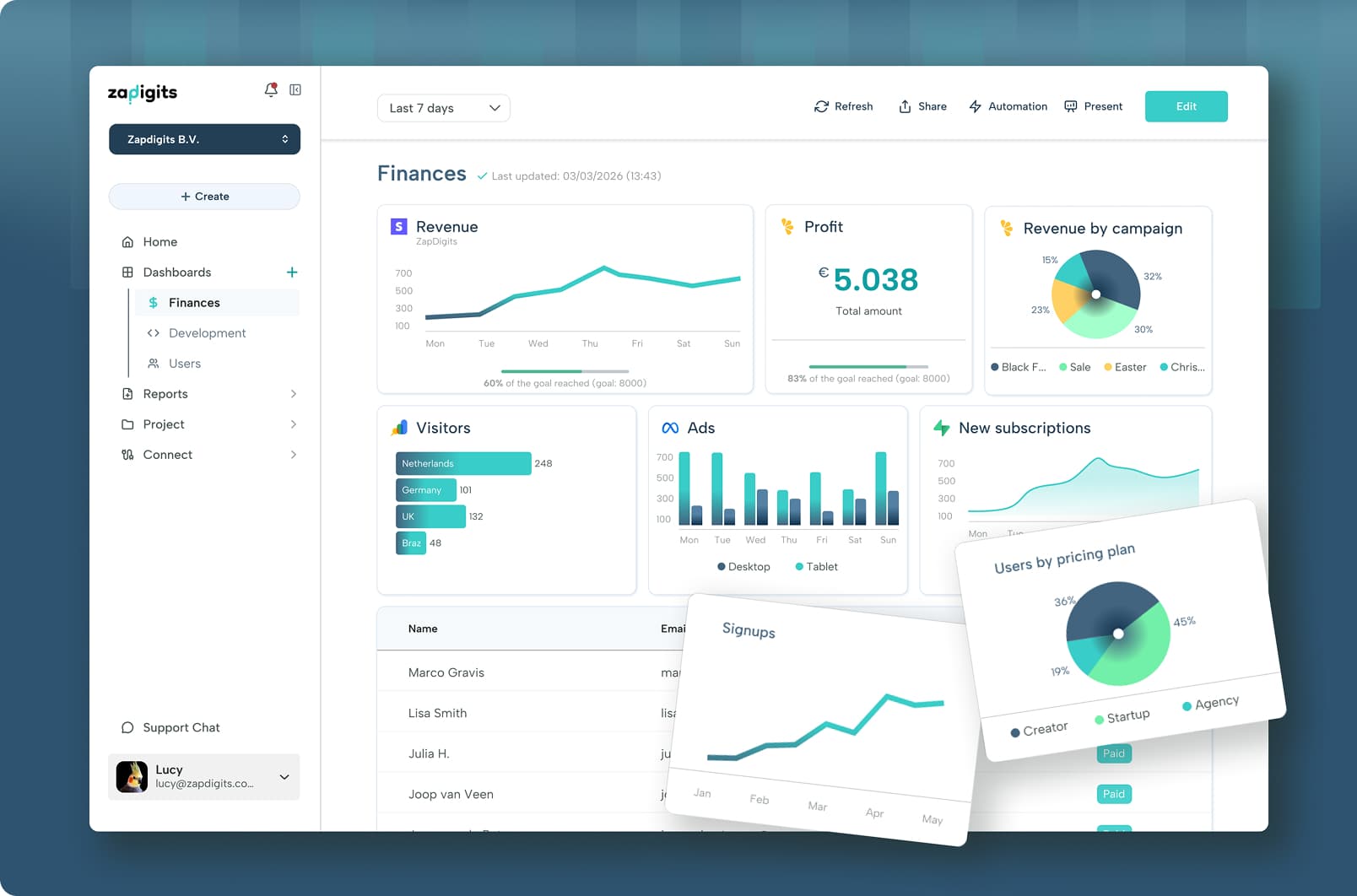
Read moreReporting without ZapDigits vs. Reporting with ZapDigits
Find answers to our most frequently asked questions. If you have mor questions, feel free to contact our support.
15 min personal demo
Let's figure it out together.
We'll take a quick look at your current setup and show you what's possible with ZapDigits. No pressure, no sales script.
Takes 15–20 minutes. You'll be talking directly with the founder.
Book a demoIn the call, you'll:
Product
Compare
Resources
ZapDigits 2025. All rights reserved. | Made in The EU 🇪🇺


